
TENSES
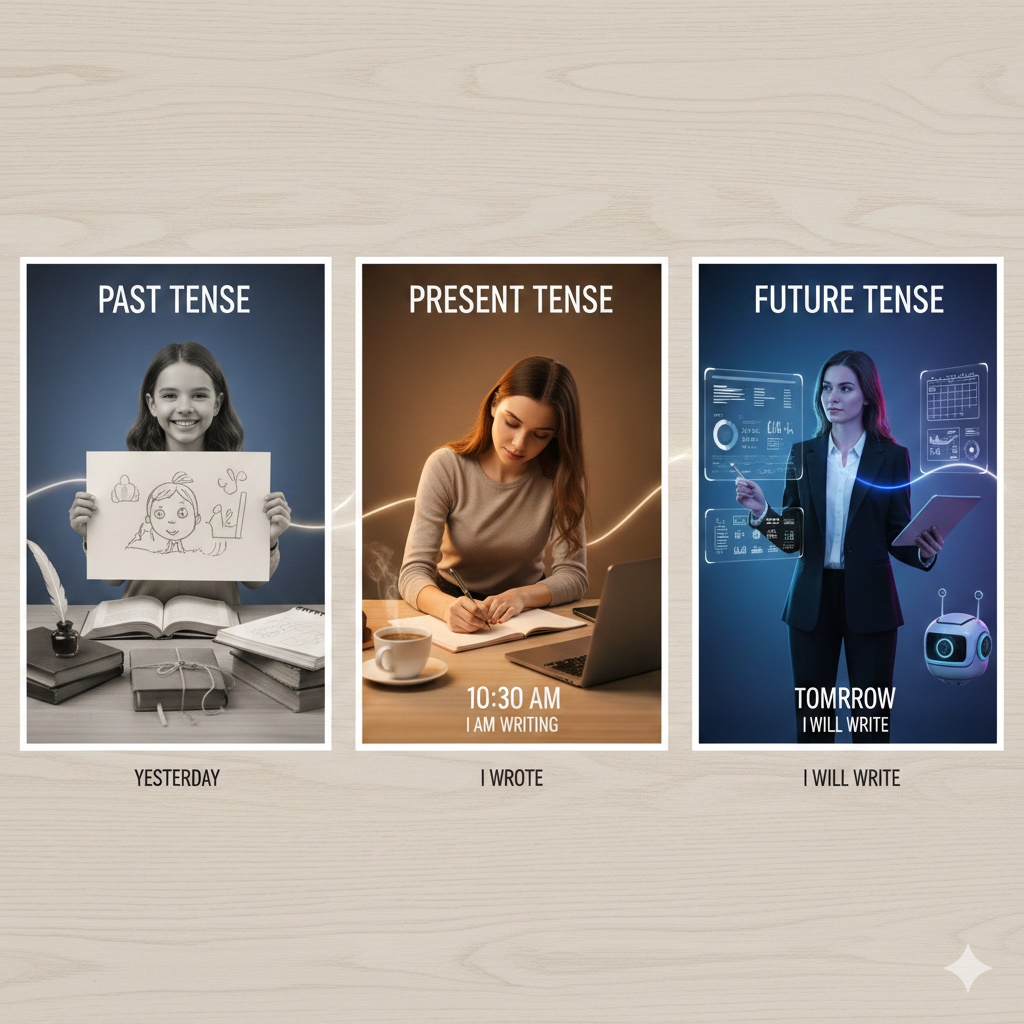
Past Tense
Present Tense
Future Tense
The Core of Tenses: What They Are
Tenses are the backbone of English grammar. They allow speakers and writers to place actions in time—past, present, or future—and indicate whether those actions are complete, ongoing, habitual, or expected. Mastery of tenses strengthens clarity, coherence, and accuracy in communication. For learners preparing for competitive exams, academic writing, or professional communication, a strong grasp of tenses is a fundamental requirement.
In English, tenses are forms of a verb that show the time an action took place. Essentially, they tell the reader or listener when something happened, is happening, or will happen.
We have three main time frames,
and within each, we have four aspects (Simple, Continuous/Progressive, Perfect, and Perfect Continuous/Progressive), which gives us a total of 12 core tenses.
1. Present Tenses (Action happening now or regularly)
-
Simple Present:
For habits, facts, and scheduled events.-
Example:
I walk to school every day. The sun rises in the east.
-
-
Present Continuous:
For actions happening right now or temporary actions.-
Example:
I am teaching about tenses. She is studying for her exams
this week.
-
-
Present Perfect:
For actions that started in the past and continue to the present, or
actions completed at an unspecified time in the past.-
Example:
We have lived here for ten years. I have finished my
homework.
-
-
Present Perfect Continuous: For actions that started in the past, continued up to
the present, and may still be continuing.-
Example:
It has been raining all morning.
-
2. Past Tenses (Action completed before now)
-
Simple Past:
For a completed action at a specific time in the past.-
Example:
She visited Paris last summer. I ate dinner an hour ago.
-
-
Past Continuous:
For an action that was ongoing in the past, often interrupted by another
simple past action.-
Example:
I was reading when the phone rang.
-
-
Past Perfect:
For an action that was completed before another past action. This is often
called “the past of the past.”-
Example:
She had left before I arrived.
-
-
Past Perfect Continuous: For an action that started in the past and continued
up until another point in the past.-
Example:
They had been working for two hours before they took a break.
-
3. Future Tenses (Action that will happen after now)
-
Simple Future:
For a decision, prediction, or promise about the future (often using will
or be going to).-
Example:
I will help you tomorrow. They are going to build a new
library.
-
-
Future Continuous:
For an action that will be ongoing at a specific time in the future.-
Example:
This time next week, I will be relaxing on the beach.
-
-
Future Perfect:
For an action that will be completed before a specific time or another
action in the future.-
Example:
By 5 PM, I will have finished the report.
-
-
Future Perfect Continuous: For an action that will have been ongoing for a
certain period of time up to a specific point in the future.-
Example:
By the end of the year, she will have been teaching for twenty
years.
-
Tips and Tricks for Mastering Tenses
Here are some practical strategies
to help your website’s content creators and your audience master tenses:
1. Focus on Time Markers
Every tense has specific time adverbs or phrases that often accompany it. Learning these is a major shortcut.
|
Tense |
Key Time Markers |
|
Simple Present |
Always, usually, every day, sometimes. |
|
Present Continuous |
Now, right now, currently, at the moment. |
|
Simple Past |
Yesterday, last week, ago, in 2020. |
|
Present Perfect |
Since, for, ever, never, already, yet. |
|
Future |
Tomorrow, next year, soon, in a few weeks. |
Tip: When you’re unsure which tense to use, look for the time
marker in the sentence!
2. Learn the Forms (Auxiliary Verbs)
Tenses are formed using auxiliary verbs (or helping verbs) in combination with the main verb. Memorizing these helpers simplifies things immensely.
-
Continuous Tenses:
Always use a form of be (am, is, are, was, were) + the main
verb’s -ing form. -
Perfect Tenses:
Always use a form of have (have, has, had) + the main verb’s
past participle form.
3. Practice Tense Consistency (Sequence of Tenses)
The most common mistake in writing is switching tenses unnecessarily within the same sentence or paragraph. This is called a shift in tense.
-
Bad Example (Shift):
The visitor clicks the button and purchased the item.
(Switches from Present to Past). -
Good Example (Consistent): The visitor clicks the button and purchases
the item. (Both Simple Present).
4. Understand Irregular Verbs
About 200 verbs in English don’t follow the regular pattern of adding -ed for the Simple Past and Past Participle (e.g., walk ——walked). You must memorize the common irregular verbs.
-
Go ——Went ——Gone
-
Speak ——Spoke ——Spoken
-
Eat ——Ate ——Eaten